







Free written scope consultation - allowances, timeline, and change-order rules on paper before a single trade is scheduled
Why San Francisco Homeowners Choose Cambria Construction
Bradford Remodeling Co San Francisco provides independent Cambria in San Francisco construction, repair, and installation, from countertop work in Pacific Heights to full kitchen remodels in the Outer Sunset. We’re not a manufacturer-authorized dealer; we’re a local remodeling crew that has worked with Cambria quartz for years and knows how this material behaves in San Francisco’s older, out-of-level homes and fog-damp climate. If your Cambria countertop is chipped, cracked, seamed wrong, or stained, call (831) 610-5598 and we’ll give you a straight diagnosis and a written price before any work starts.
Cambria is a premium quartz surface, and San Francisco homeowners choose it because it holds up to daily use without the sealing demands of natural stone. The tradeoff is that Cambria is a specific material: 93% quartz with a resin binder, fabricated to tight tolerances, and not every general contractor understands how it fails or how to fix it correctly. We do. Curtis Lane, our owner, has spent two decades working through San Francisco’s construction quirks, including a run of Outer Sunset gut-and-rebuilds where he learned exactly how fog-driven moisture moves through balloon-frame walls and what that does to finishes inside. That experience carries directly into our Cambria work.
Whether you need a new Cambria countertop installed, a thermal crack assessed, a failed seam repaired, or a backsplash tied into an existing slab, we handle it with the same discipline: straight number, real scope, no surprises at close-out.
Why Trust Bradford Remodeling Co San Francisco for Your Cambria Construction?

Cambria quartz is not a product you want a generalist guessing at. It machines differently than granite, it seams differently than laminate, and it repairs differently than Corian. Our crew has handled Cambria Brittanicca, Torquay, Swanbridge, and Windermere slabs, and we understand the specific ways each finish behaves under San Francisco conditions.
We take warranty safety seriously. Cambria’s warranty is strong on paper, but it presumes correct fabrication and installation. A poorly seated seam, an over-torqued clamp, or a slab cut without accounting for cabinet deflection can void that warranty before you ever file a claim. That is why we template carefully, shim to dead level, and spec the right support substrate, especially in San Francisco homes where floors have settled half an inch or more over a century.
We also use the right materials. For full replacements, we source genuine Cambria slabs or factory remnants. For localized repairs, we match the exact color and finish with Cambria-compatible repair compounds, not generic acrylic fillers that yellow and fail. Curtis Lane grew up in Los Angeles, trained in construction technology at Los Angeles Trade-Technical College, and still keeps a worn California Building Code on his desk. That background means our Cambria installs meet seismic fastening requirements, not just aesthetic ones.
Every Cambria job we take in San Francisco comes with The Garrison Standard in writing: a fixed price before work starts, a documented scope, and the 365-Day Done Right Promise. If our Cambria work fails within a year, we come back and correct it at no charge. No fine print, no re-quoting.
Styles & brands we work with







Common Cambria Construction Problems We Fix in San Francisco
Here are the real failure modes we see on Cambria surfaces across San Francisco, not the generic list you will find on a manufacturer’s FAQ page:
- Thermal cracks near cooktops. Direct heat from a gas range or a hot pan set directly on the surface can create hairline fissures radiating outward from the edge. Cambria’s resin binder will discolor or fissure under sustained heat, and in older San Francisco kitchens with legacy gas appliances, this is one of the most common calls we get. A thermal crack usually cannot be patched cleanly; we assess whether edge stabilization or full slab replacement is the safe route.
- Seam failure and lippage. San Francisco homes settle. A lot. Cabinets that were level in 1972 are not level now, and if an original installer cut a seam over a joint that has since moved, you get a visible ridge or an actual gap. We see this constantly in Richmond and Sunset district homes built on sand dunes, where foundation settling is chronic. The fix often requires re-shimming the cabinet run before re-seaming the slab, otherwise the seam will just pop again.
- Edge chipping on polished profiles. Cambria edges are durable, but not indestructible. Dropped cast-iron pans and heavy dutch ovens will chip a polished pencil edge, and thinner 2cm profiles are more vulnerable than the thicker 3cm slabs. San Francisco’s seismic activity adds another variable: a sharp jolt during a minor quake can cause an overhanging edge to stress against a hard surface. We repair localized edge chips with color-matched compound, and for repeat chipping, we often recommend a different edge profile on replacement.
- Water staining and etching on matte finishes. Cambria’s matte and textured finishes are more porous at the surface level than polished slabs. San Francisco’s hard water, which carries high mineral content, can leave a cloudy film that looks like etching. Improperly applied or neglected surface sealers make it worse. We strip and restore matte Cambria surfaces using Cambria-recommended cleaning protocols, not acidic cleaners that break down the resin.
- Improper sink and cooktop cutouts. We have repaired more than a few San Francisco Cambria installs where an over-aggressive fabricator cut a sink opening with tight inside corners, creating stress points that crack later. Cambria requires rounded inside corners on cutouts to distribute stress. If your previous installer cut square corners, that crack was predictable.
Cambria Parts & Our Repair-vs-Replace Approach

Cambria is a proprietary quartz surface. You cannot buy a “Cambria repair kit” at a hardware store, and anything you do buy at a big box store is going to be a generic epoxy or polyester filler that will not match your slab’s color or sheen. That is the core problem we solve.
For edge chips, surface scratches, and small impact damage, we use Cambria-compatible repair compounds matched to the exact color and finish of your slab. This work is localized and usually completed in one visit. For thermal cracks that have compromised the slab’s structural integrity, seam separation that keeps returning, or damage that spans a significant portion of the surface, we recommend replacement. Patching a structural crack on a cantilevered island overhang is not a repair; it is a delay before a bigger failure.
When we do replace, we source genuine Cambria slabs or factory remnants. We keep an active relationship with local slab yards in the Bay Area, and we can often match a discontinued or current Cambria design faster than a homeowner trying to source it independently. If you are weighing repair versus replacement on a Cambria surface in San Francisco, call (831) 610-5598 and we will be straight with you about which route actually makes sense for your situation and your budget.
Our Cambria Service Process – Step by Step
We run Cambria work the same way every time, because a disciplined process is what keeps prices fixed and results predictable.
- 1
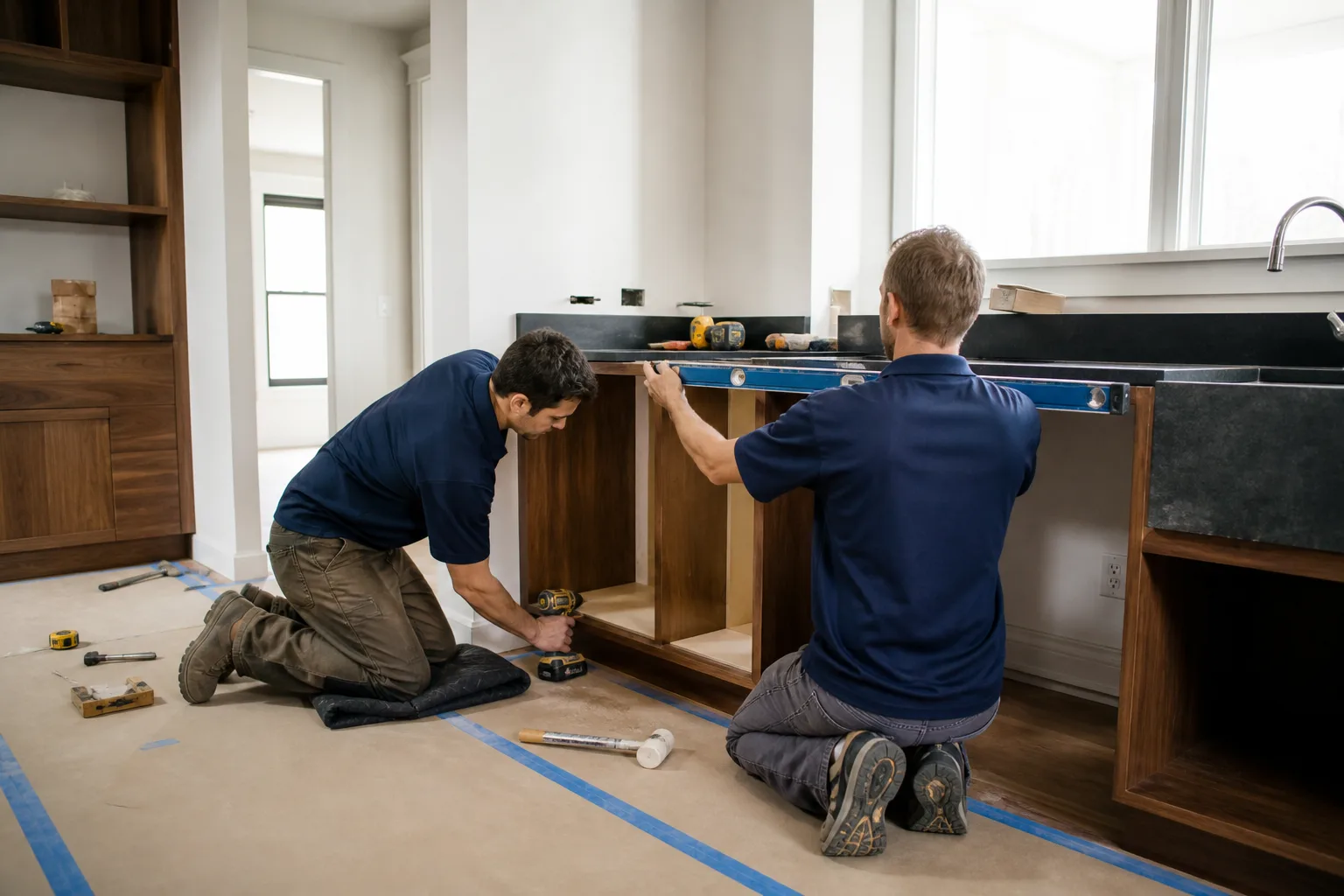
Diagnosis and measurement. We inspect the existing slab, check cabinet level across the entire run, identify stress points, and take precise measurements. For new installs, we template the actual space, not just the cabinet drawings, because San Francisco walls are rarely square. This is where we catch out-of-level conditions before they become seam failures.
- 2
Written scope and price. You get a line-item proposal with the exact Cambria design, edge profile, finish, sink and cooktop cutout details, and the total price. This number does not move at the door. The Garrison Standard is non-negotiable.
- 3
Fabrication and prep. We handle substrate leveling, shimming, and any cabinet reinforcement required before the slab goes in. If your cabinet boxes are twisting under load, we address that first. A Cambria slab is only as stable as the structure under it.
- 4
Installation and seaming. We set the slab, seam it at the correct pressure, and fasten it to code. In San Francisco, that means mechanical anchors and seismic clips where the design or the Department of Building Inspection requires them. We pull permits when the scope triggers them, and we pass inspections before we call the job done.
- 5
Testing and warranty. We run water, check seams, verify overhangs, and walk the job with you. You leave with a written 365-Day Done Right Promise: if anything fails within the year, we return and fix it at no charge.
See the difference
 Before
 After
After Before
 After
After Before
 After
AfterCambria Products We Service & Install in San Francisco
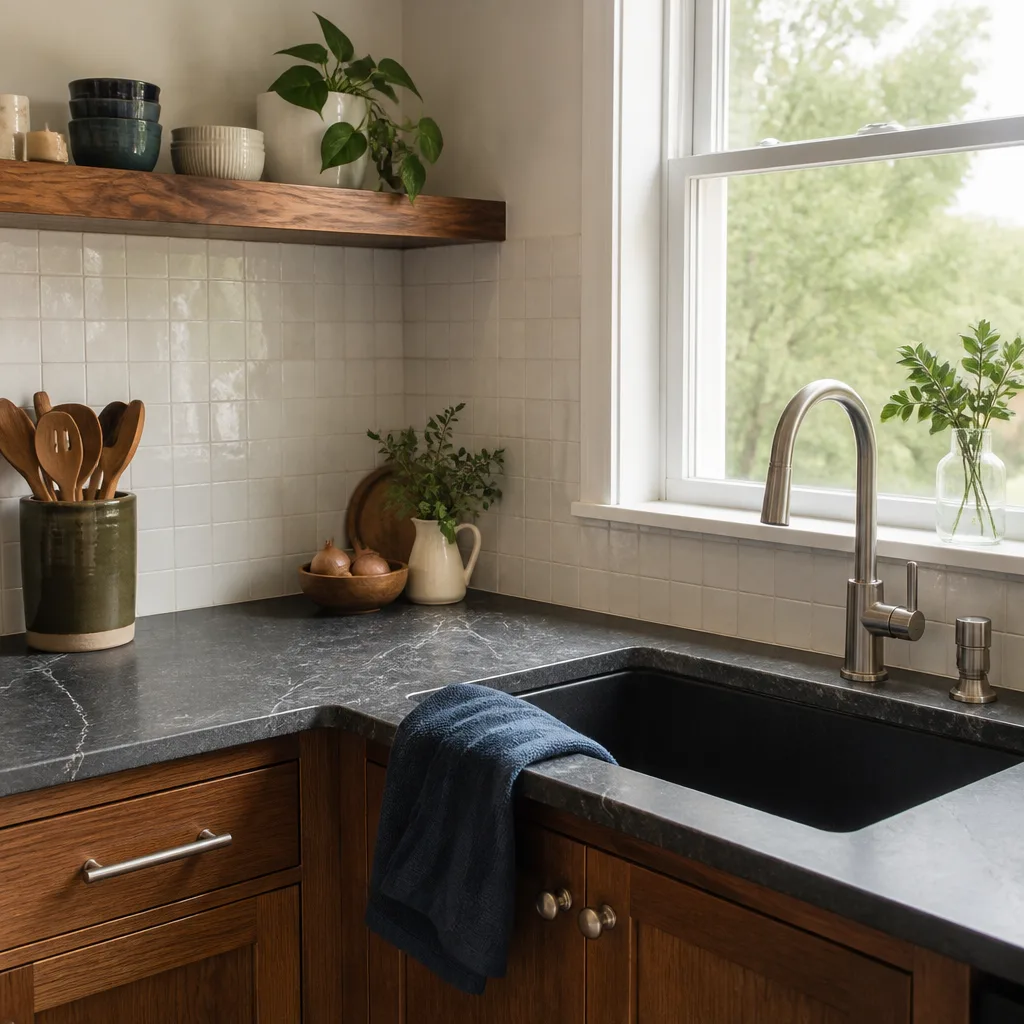
We work with the full Cambria design palette, including the finishes that are most popular in San Francisco homes right now: Brittanicca, with its warm marble-like veining; Torquay, a high-contrast white and gray option that fits both modern and transitional kitchens; Swanbridge, a quieter, softer pattern that reads well in smaller spaces; and Windermere, a warmer earth-toned design that pairs well with natural wood cabinets.
We install Cambria on kitchen islands, perimeter countertops, bathroom vanities, wet bars, fireplace surrounds, and custom applications. For small projects, we actively source Cambria remnants from Bay Area slab yards, which can cut the material cost substantially on a bathroom vanity or a compact kitchen island in San Francisco. When a specific Cambria design is backordered or discontinued, we will tell you on day one and help you pick an alternative rather than stringing the job along.
We Also Service These Brands
Bradford Remodeling Co San Francisco works with a documented roster of premium materials, not just Cambria. We also install and service KraftMaid and Wellborn cabinetry, Silestone and Caesarstone quartz, Kohler and Moen fixtures, and Toto plumbing. That matters because your Cambria countertop does not exist in isolation; it sits on cabinets, meets a backsplash, and surrounds a sink and faucet, and we can handle the whole scope without farming pieces out to subcontractors.
FAQs – Cambria Construction Service in San Francisco
Yes, in many cases. Localized edge chips, surface scratches, and small impact marks can be repaired with Cambria-compatible color-matched compound, and the repair will hold if the surrounding slab is structurally stable. What we cannot repair safely is a thermal crack or a crack that runs through the slab’s thickness. If the structural integrity is compromised, we will recommend replacement and explain why patching would be a false economy. Call (831) 610-5598 and we will give you an honest assessment, not a sales pitch.
We level the cabinets first. That is the actual answer. A Cambria seam will not hold over a cabinet joint that is moving or out of level by more than the manufacturer’s tolerance, and in older San Francisco homes that tolerance is often exceeded. We shim the cabinet run, verify with a laser level, and only then cut and set the seam. If the cabinets are too far gone, we will quote cabinet reinforcement or replacement as part of the scope rather than promising a seam that will pop in six months.
Yes. For small projects like a bathroom vanity, a wet bar top, or a compact kitchen island in San Francisco, we source Cambria remnants from Bay Area slab yards. A remnant can often cut the material cost in half versus buying a full slab, and the installation quality is identical. We will always tell you if the design you want is available as a remnant or if you need to wait for a full slab order, so the price you get is the price you pay. Call (831) 610-5598 for a written quote on your project.
We strip the buildup and restore the surface using Cambria-recommended cleaning protocols, not abrasive pads or acidic chemical cleaners that damage the resin binder. San Francisco’s hard water is the underlying problem, and the clouding you see on a matte Cambria finish is usually mineral film, not true etching from acid. Once we restore the surface, we will show you exactly what to use for routine cleaning and what to avoid, so the problem does not come back.
Yes. San Francisco’s building code requires mechanical anchoring for certain countertop and island configurations, especially free-standing islands and cantilevered overhangs, and the Department of Building Inspection enforces these requirements. We fasten Cambria slabs with code-compliant mechanical anchors and seismic clips where the design and location require them. We pull permits when the scope triggers a permit requirement, and we do not close out the job until the inspection has passed. That is part of The Garrison Standard.
Cambria countertop installation in San Francisco typically runs between $2,360 and $7,670 depending on slab size, edge profile, and the condition of the existing cabinets. Cambria backsplash installation generally falls between $945 and $2,950. A custom Cambria kitchen island top, including fabrication and installation, is usually $3,540 to $11,800. We give you an exact written price after we template and inspect the space, before any deposit changes hands, and that number does not move at the door. Call (831) 610-5598 to schedule a free estimate.
No. We are an independent San Francisco remodeling and construction company, not a Cambria-authorized dealer or warranty provider. We have worked with Cambria quartz for years, we source genuine Cambria slabs and remnants, and we repair using Cambria-compatible materials, but any warranty claims are handled through Cambria’s own process, not ours. Our own 365-Day Done Right Promise covers our workmanship for a full year regardless of manufacturer warranty status.
For full slab replacements, we use genuine Cambria quartz sourced from authorized Bay Area slab yards. For localized repairs, we use Cambria-compatible repair compounds matched to your exact slab color and finish. We never install generic quartz and call it Cambria, and we never patch a Cambria surface with hardware-store acrylic fillers that yellow, shrink, and fail within months. If you want to know precisely what materials your repair will use, ask us for the written scope and we will itemize it.
Most localized repairs, like edge chips, small scratch resurfacing, and seam re-leveling, are completed in one visit. Full slab replacements run longer because of template creation, fabrication time, and installation sequencing. A typical San Francisco kitchen island replacement takes roughly one week from template to completed install, depending on slab availability. We will give you a written timeline with your proposal, and if it shifts, we will tell you before you have to call and ask.
We service and install the full Cambria design range currently available in the U.S., including Brittanicca, Torquay, Swanbridge, Windermere, and discontinued patterns that can still be sourced through remnants. If you have a Cambria design that is no longer in production and you need a matching piece, we will search Bay Area remnant inventory before advising you on whether a repair or a complementary replacement design makes more sense.
Book Your Cambria Service in San Francisco, CA
If your Cambria countertop needs repair, replacement, or a fresh installation, call Bradford Remodeling Co San Francisco at (831) 610-5598. We will set up a site visit, give you a straight diagnosis, and put a written price in your hand before any work starts. Straight number, real scope, no surprises at close-out.
Written by Curtis Lane, Owner at Bradford Remodeling Co San Francisco, serving San Francisco since 2004.


