








Free written scope consultation - allowances, timeline, and change-order rules on paper before a single trade is scheduled
Schluter Kitchen Remodeling: The San Francisco Owner’s Guide
A full Schluter kitchen remodeling project in San Francisco typically runs between $16,520 and $53,100 installed, depending on cabinet footprint, countertop surface area, and how much of the existing substrate has to come out before new Schluter waterproofing and tile systems go in. We stock Schluter profiles, KERDI membrane, DITRA underlayment, and transition strips on our trucks, and we install them on a fixed written scope. Most San Francisco owners call us after water has already found its way behind a failed edge or seam: grout lines cracking along a Schluter profile, a KERDI band peeling at a corner, or a DITRA layer delaminating because the thinset underneath was never properly keyed into the subfloor.
Schluter makes the systems that keep a kitchen tile assembly from failing where water and expansion stress concentrate. When any part of that system underperforms, the fix is usually not a patch job. It is a controlled removal, a corrected substrate, and a new installation sequenced the way Schluter’s own specs require. We have torn out enough failed Schluter work in San Francisco to know exactly what that looks like, and we put the replacement scope in writing before we move a single cabinet.
Key Takeaways:
- Full Schluter kitchen remodeling in San Francisco: $16,520 – $53,100 installed.
- We stock Schluter KERDI, DITRA, profiles, and corners on the truck.
- Written price before work starts, every time. No numbers that move at the door.
- Every completed job carries the 365-Day Done Right Promise in writing.
- Bradford Remodeling Co San Francisco is an independent contractor, not affiliated with Schluter Systems.
Which Schluter Models This Applies To

Schluter is not one product. It is a family of interconnected systems, and getting the right replacement part depends on knowing which generation of product is in your kitchen and what it was originally bonded to. We work across the full current lineup: KERDI waterproofing membrane, KERDI-BAND for seams and corners, DITRA and DITRA-HEAT uncoupling and heating underlayments, and the full range of Schluter metal finishing profiles including SCHIENE, RONDEC, QUADEC, and DECO.
Here is the compatibility gotcha most San Francisco homeowners do not know: DITRA and DITRA-HEAT are not interchangeable. If your kitchen was floored with DITRA-HEAT and you now have a failed section, you cannot drop a plain DITRA sheet into that hole and expect the tile assembly to respond the same way to heat expansion. The two products have different thicknesses, different waffle geometry, and different thinset bonding requirements. Same story with KERDI versus KERDI-DS, which is a thicker vapor-retarding membrane spec’d for steam applications. If a contractor says “it’s all the same membrane,” that is your cue to hire someone else.
On the aftermarket question: Schluter does not license third-party equivalents. We use genuine Schluter components for every membrane, band, corner, and profile install. The profile metal is what most often gets substituted with generic aluminum trim from a box store, and we have seen enough pitting and edge corrosion on those generics in San Francisco’s salty, fog-heavy air to refuse them. Genuine Schluter profiles are anodized aluminum or stainless steel with a warranty-backed finish spec. When the profile is gone, the tile edge is exposed, and that is how water gets behind the assembly.
If you are trying to identify which Schluter product is in your kitchen, check the back of any loose profile for the etched Schluter name and product code, or look for the orange KERDI or DITRA branding on exposed membrane before it was tiled over. We can also identify the system from the tile assembly once we open a small section, which is part of what our initial estimate includes.
Styles & brands we work with







Signs Your Schluter Kitchen Remodeling Is Failing
- Grout lines cracking in a straight line along a metal edge profile. This is almost always profile movement caused by inadequate bonding or the wrong thinset under the profile’s anchoring leg. Schluter profiles need a continuous bed of thin-set under the full length of the leg. When installers dot-set them, the profile flexes under foot traffic and the grout line above it fails first.
- A hollow sound when you tap the floor tile near the sink or dishwasher. That is the classic symptom of DITRA delaminating from the subfloor. In San Francisco kitchens with older plywood subfloors and years of moisture cycling, the unbonded areas grow until the tile above cracks or shifts.
- Water staining or swelling at the base of cabinets that sit against a tiled backsplash. The KERDI membrane or KERDI-BAND at that wall-to-floor transition was either not lapped correctly or was punctured during cabinet setting. Once moisture moves behind the membrane in that location, it travels sideways along the wall cavity. The visible stain often shows up two or three feet from the actual breach.
- Corners of the backsplash pulling away from the wall behind the range or cooktop. This is a substrate failure, not a tile failure. The drywall or plaster behind the KERDI was not sound enough to carry the membrane’s bond. Heat cycling behind a range accelerates the separation. In older San Francisco homes with lath-and-plaster walls, this failure pattern is common enough that we inspect the wall cavity before any new KERDI goes up.
- Discoloration or rust staining at a metal profile on an exterior-facing kitchen wall. That tells you the profile was set in an environment where the finish spec was wrong. San Francisco fog carries salt and moisture. On walls with any exterior exposure, we spec stainless steel profiles, not standard anodized aluminum. The rust is the visible symptom; the underlying problem is moisture wicking along the profile’s leg into the tile assembly.
See the difference
 Before
 After
After Before
 After
After Before
 After
AfterReplacement Cost & What’s Included
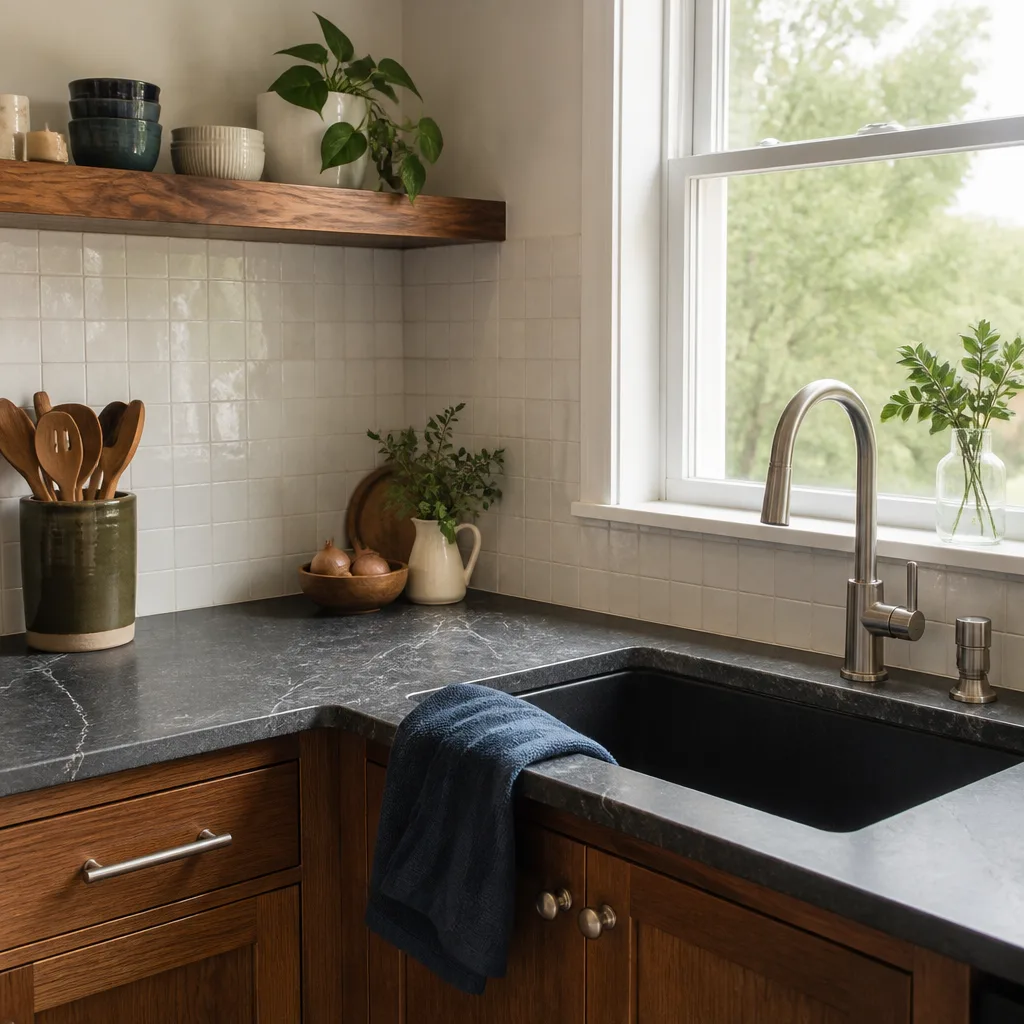
A complete Schluter kitchen remodeling in San Francisco ranges from $16,520 to $53,100 installed. A smaller kitchen with a modest footprint can run $10,620 to $23,600, while countertop installation alone typically lands between $2,360 and $7,670. Backsplash installation with the full KERDI waterproofing assembly runs $945 to $2,950. Those are the broad numbers; every job we price gets a line-item written scope with the exact square footage, membrane type, profile footage, and labor broken out so you can see where the money goes.
What drives the range in San Francisco is almost always the substrate condition. In a newer home with clean plywood and sound drywall, the Schluter installation is straightforward. In a 1920s Outer Sunset kitchen with balloon-frame walls, settled floors, and moisture history, we are correcting the substrate before the first sheet of DITRA or KERDI ever goes down. That correction work is real scope and it belongs on the written estimate, not in a surprise change order later. Every replacement install we do includes genuine Schluter components, correct thin-set mortars matched to the product, removal and disposal of the failed assembly, and a full-year written guarantee under the 365-Day Done Right Promise.
DIY or Call Us?
You can safely check a few things yourself. Tap the floor tile to map the hollow spots. Look for grout cracks that run in straight lines. Pull the bottom drawer out of a cabinet and check for water staining where the floor meets the wall. Nothing in that inspection will hurt you or the tile assembly. But that is where the DIY window closes.
Removing failed KERDI or DITRA means cutting into the tile assembly, grinding down thin-set, and often exposing the subfloor or wall cavity. The dust alone from cutting tile and thin-set in a San Francisco kitchen requires full containment. The rebuild has to be sequenced into Schluter’s own curing and bonding windows, and if the bonding surface is not prepared exactly right, you are paying for the same failure a second time. We have replaced plenty of homeowner Schluter repairs that lasted under a year because the thin-set was mixed too wet or the DITRA was not embedded while the mortar was still open. If you want the job done once, call (831) 610-5598 and we will give you a straight number.
FAQs
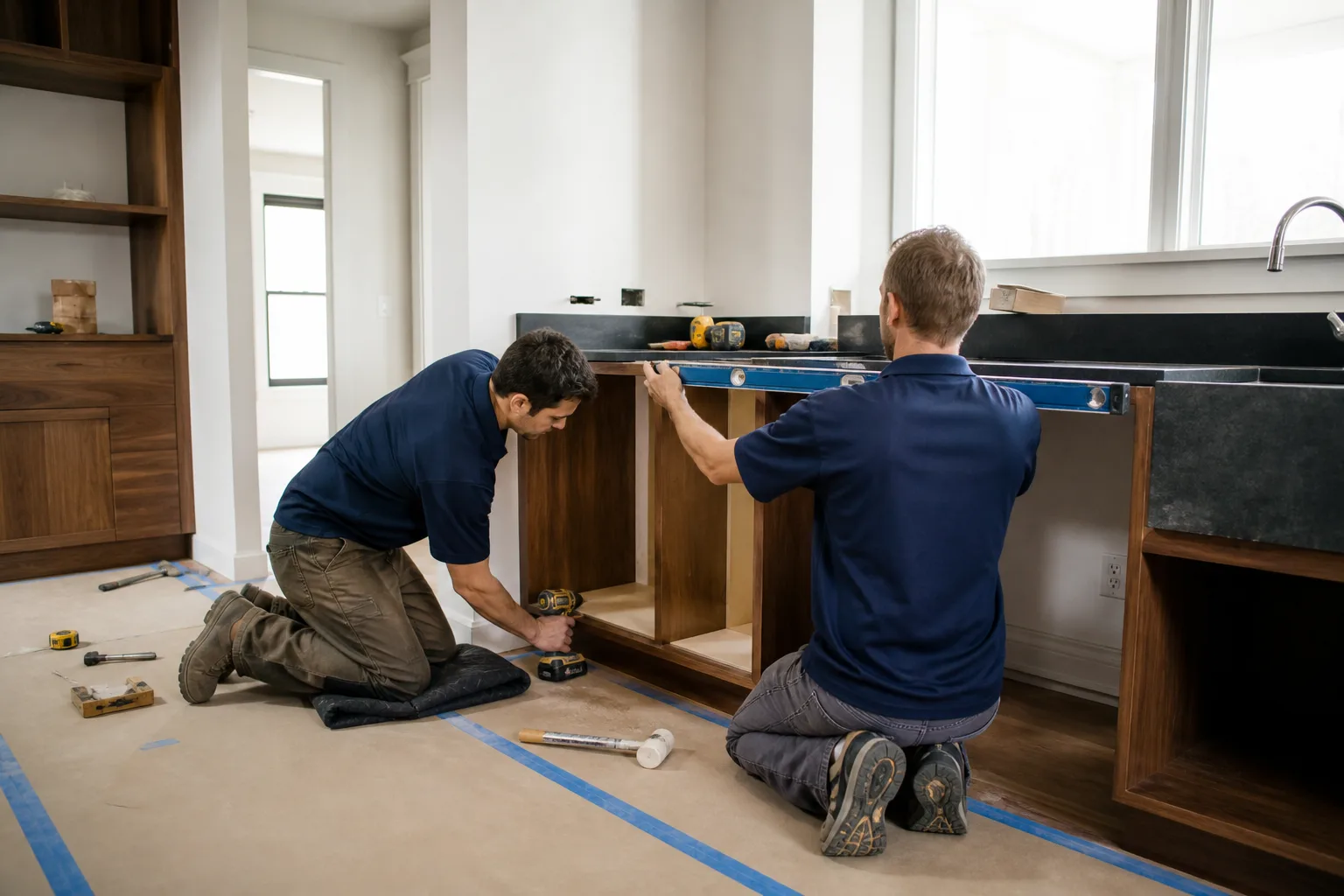
A correctly installed Schluter waterproofing and uncoupling system should last 25 years or more in a San Francisco kitchen. The membrane and profiles do not degrade on their own; what fails is the installation around them, typically within the first five years if the thin-set bonding or surface prep was wrong.
The honest answer is rarely. You can patch a small section of KERDI at a corner if the surrounding membrane is sound and you can achieve the required 2-inch minimum overlap. But once water has moved behind the membrane or the DITRA has delaminated across a broad area, a patch becomes a hidden future failure. Most of what we see in San Francisco kitchens is past the patch point by the time it is visible. Call (831) 610-5598 and we will tell you which situation you have.
A full tear-out and rebuild of a Schluter kitchen assembly, including substrate correction, membrane installation, tile, and profiles, typically runs two to four weeks in San Francisco. Floor-only replacements go faster. The curing windows for thin-set and grout are fixed; we do not shorten them, because that is how the next failure starts.
We keep KERDI membrane, KERDI-BAND, KERDI corners, DITRA and DITRA-HEAT, and the most common SCHIENE, RONDEC, and QUADEC profiles stocked on our trucks in standard finishes. Non-standard finishes and longer profile runs may need a two-to-three-day order window. Before work starts, we confirm exactly which Schluter products your kitchen needs and that they are on-site or scheduled for delivery.
Written by Curtis Lane, Owner, Bradford Remodeling Co – San Francisco, CA at Bradford Remodeling Co San Francisco, serving San Francisco and nearby areas.


