







Free written scope consultation - allowances, timeline, and change-order rules on paper before a single trade is scheduled
Cambria Kitchen Remodeling: The San Francisco Owner’s Guide
If you have a Cambria countertop, island, or backsplash that’s cracked, chipped, stained past saving, or pulling away at the seams, this is the page that answers your real questions. A full Cambria kitchen remodel in San Francisco runs $16,520 – $53,100 installed, depending on square footage, layout changes, and whether cabinets or plumbing move. We match replacement Cambria quartz exactly to your existing design, handle the tear-out and disposal, and put the new surface down on a substrate we guarantee in writing.
Most homeowners call us after the third or fourth band-aid fix. A chip at the sink edge sealed with epoxy that keeps yellowing. A seam that’s opened up twice. A crack that started at the cooktop cutout and crept three inches before anyone really looked at it. By that point the question isn’t whether to fix it. It’s whether to patch it again or replace the surface entirely and finally do the kitchen the way it should have been done the first time.
Here’s the straight answer: if the damage is structural, you replace. If it’s cosmetic and isolated, we’ll tell you that too. Curtis Lane reads the slab before he reads the room.
Which Cambria Models This Applies To

Cambria quartz is manufactured in Minnesota, and the brand runs a tighter color and pattern control than most imported quartz. That doesn’t mean every slab labeled “Brittanicca” or “Torquay” is identical from batch to batch. Veining shifts. Undertones drift warm or cool by a few degrees. If you’re replacing one section of a larger run, we pull the batch code from the underside of the existing slab and have the Cambria distributor hold a sample for side-by-side matching before we cut anything. That’s a step a lot of shops skip, and it’s the difference between a seam you can’t find and one you’ll see every time you walk in the room.
The part specifics that matter: Cambria slabs run 2 cm or 3 cm thick, and standard counters are fabricated at 3 cm. Edges are profile-cut per design (eased, beveled, ogee, or waterfall), and sink cutouts are either drop-in or undermount. If your undermount sink lip is chipping at the rim, the issue is usually the cutout’s overhang spec, not the sink. We recut and polish the inside lip to Cambria’s fabrication tolerance, which is tighter than most field repairs allow.
One compatibility gotcha worth knowing: Cambria does not authorize field polishing or “spot repair” kits for through-body chips. The manufacturer’s position is that a chipped edge or cracked slab gets replaced, not patched. We’ll match the replacement slab to the original batch when possible, and when the original color is discontinued, we’ll give you the three closest current colors with sample chips in hand before you decide.
We’re an independent San Francisco contractor. We install and repair Cambria surfaces, but we are not a Cambria company location and we don’t speak for them. We do follow their fabrication specs to the letter, because a warranty claim only works if the install was done right.
Styles & brands we work with







Signs Your Cambria Kitchen Remodeling Is Failing
Quartz doesn’t fail quietly. Here’s what we see on service calls across San Francisco, from the Marina to the Excelsior.
- A crack growing from the cooktop cutout. Heat expansion at the cutout corners is the leading cause. The quartz can’t flex, so it cracks. If the crack has passed the 45-degree corner radius, the slab needs replacement. Patching won’t hold under continued heat cycles.
- A seam that keeps separating. This is almost always a substrate problem. The plywood or MDF underneath has swelled, usually from a slow sink or dishwasher leak. Regluing the seam without drying or replacing the substrate means the seam opens again in six months.
- Chipping along the sink edge or counter overhang. In San Francisco’s older homes, cabinets settle. A slab that was dead level at install can drop an eighth of an inch at the sink run over three or four years. That puts the unsupported edge under stress every time someone leans on it.
- Discoloration or fogging that won’t clean off. Cambria is non-porous, but a breakdown in the surface polish from abrasive cleaners can leave a dull, cloudy patch. Once the gloss is compromised, you can’t restore it with household products.
- A backsplash pulling away from the wall. In San Francisco kitchens without proper ventilation, moisture works its way behind the slab and softens the thinset bond. You’ll see a hairline gap at the top edge, then the slab will start to sound hollow when tapped.
See the difference
 Before
 After
After Before
 After
After Before
 After
AfterReplacement Cost & What’s Included

Here’s the number, as promised. A full Cambria kitchen remodel in San Francisco runs $16,520 – $53,100. On the lower end, you’re keeping the existing footprint, cabinets, and plumbing, and replacing countertop, backsplash, and sink. On the upper end, you’re moving walls, replacing cabinets, adding an island, and redoing the electrical rough-in. A countertop-only replacement runs $2,360 – $7,670 installed.
| Scope | San Francisco Installed Price |
|---|---|
| Countertop replacement (Cambria, 3 cm) | $2,360 – $7,670 |
| Backsplash (Cambria, full height) | $945 – $2,950 |
| Kitchen island (new, with Cambria top) | $3,540 – $11,800 |
| Full kitchen remodel (Cambria surfaces) | $16,520 – $53,100 |
Every job gets a written line-item price before work starts. That price includes tear-out, substrate inspection and replacement if needed, slab fabrication, install, plumbing disconnect and reconnect for the sink, and haul-away. It does not move at the door. If the substrate is rotted from a leak nobody could see until the old top came off, we stop, show you, and give you a written change order before we touch it. No surprise invoices, ever.
All work carries our 365-Day Done Right Promise: if the install fails inside a year, we come back and correct it at no charge. That’s in writing, signed, with the scope document at job close.
DIY or Call Us?
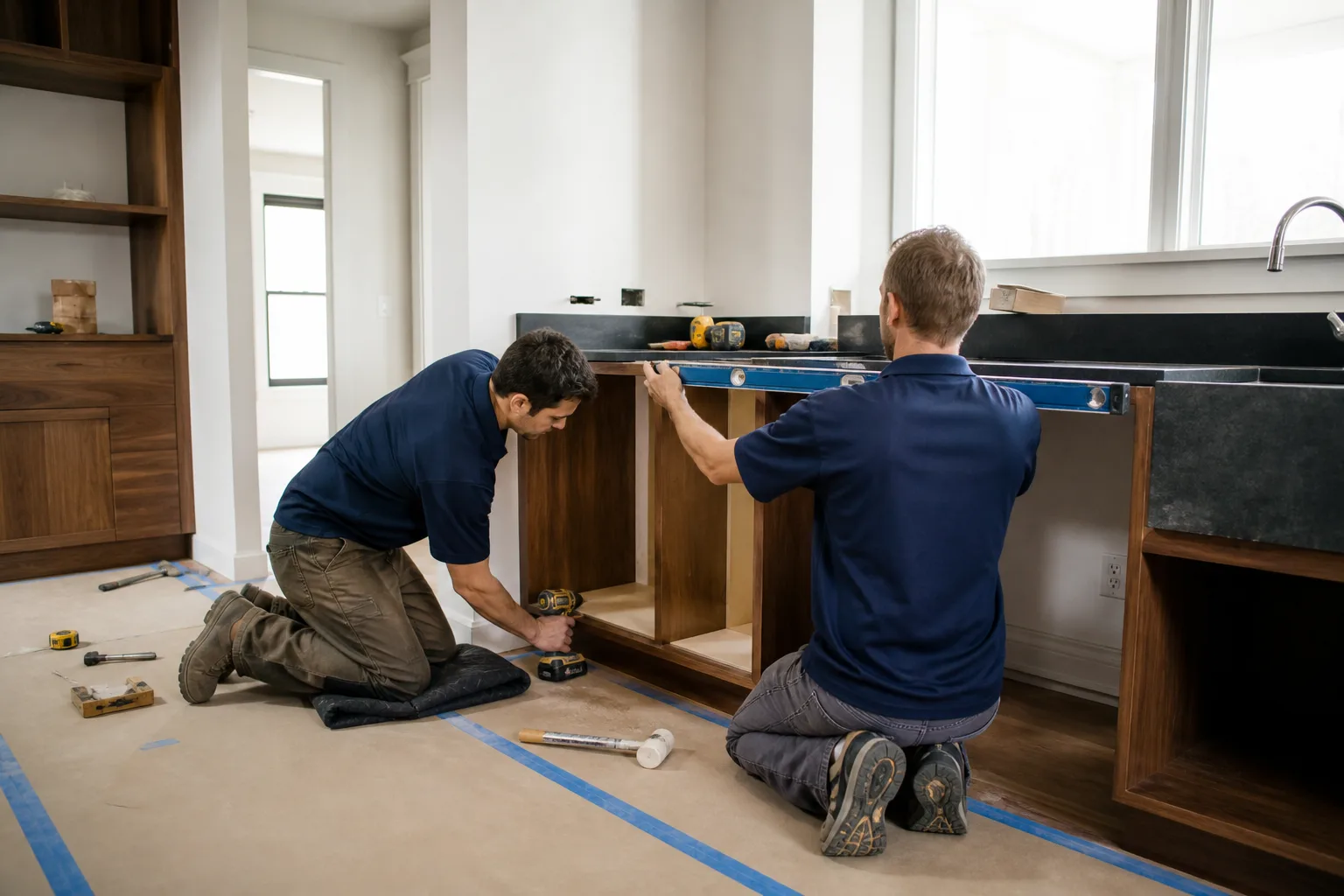
Quartz is heavy, brittle, and unforgiving. A 3 cm Cambria slab weighs roughly 18 pounds per square foot. A standard 25-square-foot island top is 450 pounds. Moving it without the right carts, suction cups, and a level substrate means cracked corners, blown seams, and a slab that’s scrap before it’s installed. This is not a job for a Saturday and a helper from Craigslist.
What you can do safely: take photos of the damage with a tape measure in frame, find the batch code on the slab’s underside (it’s printed on a label near a corner), and check under the sink for moisture or swelling in the cabinet base. Those three pieces of information let us give you an accurate estimate over the phone. Then let us handle the rest.
Call (831) 610-5598 and ask for Curtis. We’ll give you a real number for your San Francisco kitchen, not a guess and a “we’ll see when we get there.”
FAQs
Cambria quartz carries a lifetime manufacturer’s warranty for the original owner, and the surface itself should last 25 years or more under normal use. The weak points in San Francisco are the substrate and the seams, not the quartz. Coastal moisture, older cabinet framing, and settle-prone homes put stress on the support structure, and that’s what fails first. We inspect the substrate as part of every cabinet or counter replacement, and we won’t put a new slab down on wood that’s already softening.
No, not reliably. Through-body cracks in quartz cannot be bonded in a way that restores the structural integrity, and Cambria’s own position is replacement, not patch. A hairline surface scratch can sometimes be polished out by a fabricator, but a crack that runs through the slab’s thickness means a new piece. Call (831) 610-5598 and we’ll tell you over the phone which one you’re dealing with based on a few photos.
From template to install, a countertop replacement in San Francisco runs about 7 to 10 days. Template takes an hour on day one. Fabrication runs 5 to 7 days at the shop. Install takes a full day, including tear-out, substrate work, sink reset, and plumbing reconnect. A full kitchen remodel with Cambria surfaces runs 6 to 12 weeks depending on cabinet lead times and whether we’re moving plumbing or electrical. We’ll put the schedule in the written scope.
We order Cambria slabs per job, matched to your batch code or color selection, through the authorized California distributor. We work with KraftMaid and Wellborn cabinetry, Silestone and Kohler for fixtures, and Cambria for quartz surfaces, so the material spec is traceable from the distributor’s invoice through to the install. Nothing is pulled from a warehouse rack and hope-and-prayed into place. Straight number, real scope, no surprises at close-out.
Written by Curtis Lane, Owner, Bradford Remodeling Co – San Francisco, CA at Bradford Remodeling Co San Francisco, serving San Francisco and nearby areas.


